An enterprise AI discussion often begins with the model: which is more accurate, faster, or cheaper? A working deployment also needs answers about data processing, infrastructure ownership, integration, and updates. The same use case can call for different architecture in different organizations.
This guide compares options without declaring a universal winner. Architecture options are not a list of equally available Yasnora deployments; current product status appears below.
Start with the data path
Take one process, such as answering questions from internal instructions. Mark where source documents, the search index, retrieval, inference, logs, and the final answer live. Identify who may change settings. If processing crosses an infrastructure boundary, show the crossing on the diagram instead of hiding it behind the word “hybrid.”
Check the right to use each source. Customer data, trade secrets, and personal data may have different access and processing rules. Location alone does not prove compliance: the configuration, agreements, and evidence matter.
Four architectural options
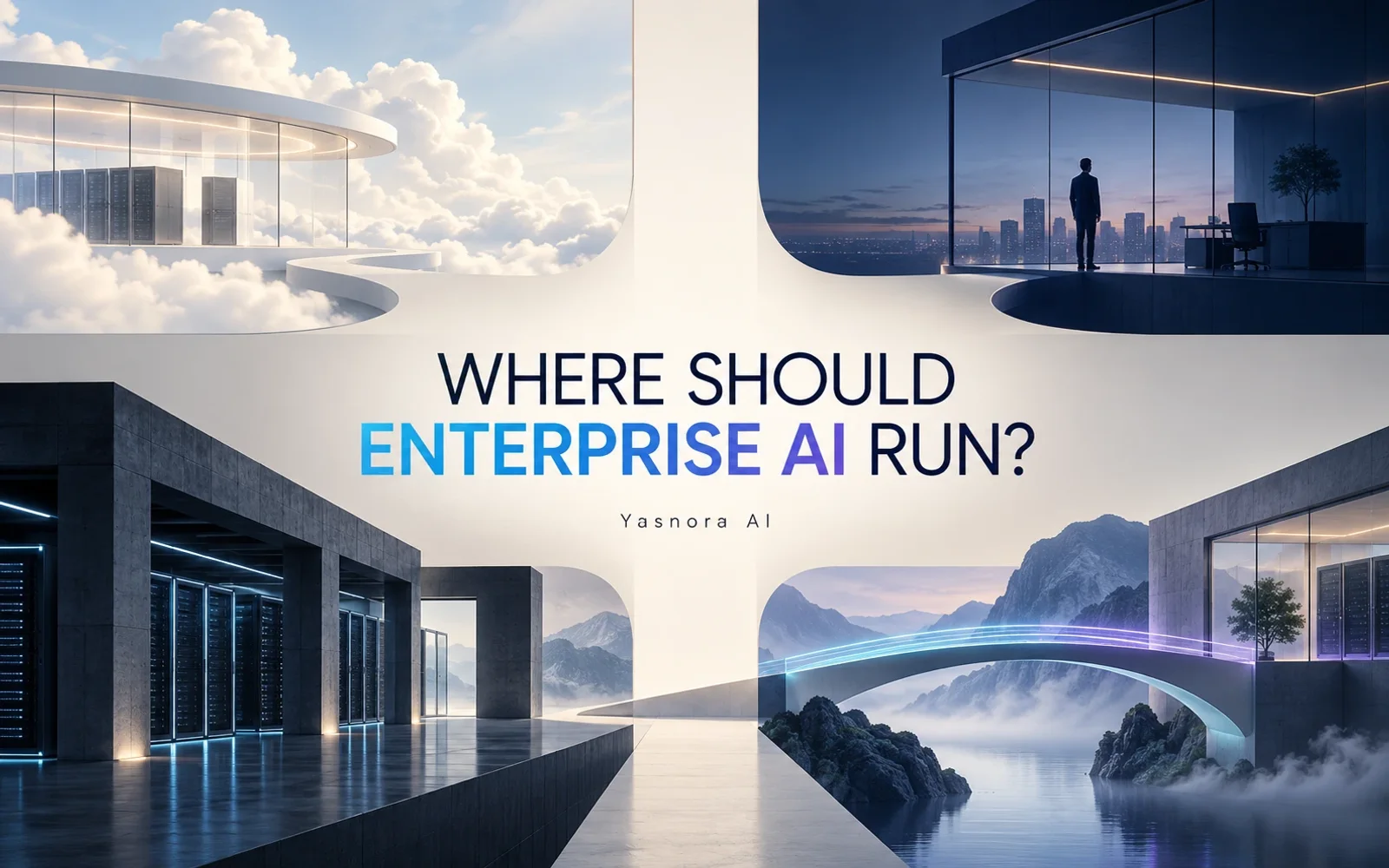
Managed cloud. The provider operates the service infrastructure; the customer starts with an account, access settings, and a bounded pilot. This lowers the customer's infrastructure burden but calls for a review of data routes, integrations, availability, and contract terms. Yasnora managed SaaS is labelled Beta. There is no published high-availability or SLA guarantee.
Customer Cloud. Components run in a customer-controlled or customer-dedicated cloud environment. This can give the customer more control over networking and integrations, while adding operational work: credentials, updates, monitoring, and recovery. Yasnora's private-cloud and customer-dedicated profiles are currently Planned. Treat this as a subject for technical assessment, not a shipping configuration.
On-premises. Components run in the customer's infrastructure. Specify compute and GPU capacity, permitted models, updates, monitoring, recovery, and outbound connections in advance. Yasnora On-Prem is Beta. Its packaging denies outbound access by default, but signed artifacts and a customer recovery drill are still required. On-premises is not automatically secure or compliant.
Hybrid. Some components stay inside the organization; others run in a cloud. For example, local retrieval over approved documents could be paired with remote inference if processing rules permit it. The network boundary, latency, monitoring, and ownership become more complex. This is an illustrative architecture, not a claim that Yasnora ships a universal hybrid profile.
| Criterion | Managed cloud | Customer Cloud | On-premises | Hybrid |
|---|---|---|---|---|
| Pilot setup | Usually less customer infrastructure work | Customer environment must be prepared | Local resources and installation required | Both environments and their connection required |
| Operations | Primarily provider-run service | Shared by agreement; substantial customer role | Primarily customer-run | Split responsibility |
| Data boundary | Verify routes and terms | Defined by customer-cloud configuration | Defined by local configuration | Depends on each data flow |
| Integration | Through available, permitted connections | Through agreed networking and access | Through internal systems | Across both boundaries |
| Scaling | Depends on service and plan | Depends on customer cloud resources | Depends on local capacity | More complex to forecast |
| Key question | Are the processing rules sufficient? | Who operates and updates the environment? | Is the team and capacity available? | What data crosses the boundary? |
These are common engineering consequences, not a product ranking.
Ten questions before choosing
- What data must the AI read, and where may it be processed?
- Must source files, indexes, and history remain in one environment?
- Which internal systems need read or write access?
- Who handles installation, keys, updates, and incidents?
- Are GPU/compute resources and operators available?
- What latency is acceptable for this process?
- What availability and recovery requirements are actually contracted?
- How often will models, instructions, and knowledge sources change?
- Is demand steady or bursty?
- What needs customization: model, policy, sources, or interface?
Begin with one process and one accountable owner. Record permitted data, quality criteria, and how the result will be checked. A pilot then gives you evidence for discussing deployment, operating cost, and contractual commitments.
If the process uses an agent, distinguish permission to read data from permission to change it. Our guide to agent permissions and control covers that boundary.
Discuss an enterprise Yasnora architecture with the Wicsora team. A particular configuration and its terms require separate assessment.